
Self Employed mortgage solutions
Your Accountant Did Their Job.
Now Let's Do Ours
What Is Stopping Most Self-Employed Borrowers
Before They Start?
Most Self-Employed Borrowers Don't Know These Options Exist
The Knowledge Gap
You qualified for a mortgage before you were self-employed. You showed your pay stubs and got approved. That process changed when your income structure did, and nobody told you.
The Conflict
Your Bank Wants High T4 Income. Your Accountant Made Sure You Don't Have It.
Lenders want a 2-year average of declared income to cover your debts. Your accountant's job is to minimize that number. These two systems are in direct conflict.
The Assumption
Your bank looked at one system and said no. Most people stop there. What they don't know is that there are lenders who look at your business bank statements instead. That is a different calculation entirely, and it opens doors the bank left closed.
You are making the money. You are just not reporting it the same way.
There is a solution built around that reality.
IN THEIR WORDS
Your Personalized Path to Mortgage Approval
Your Revenue Tells the Story Your T4 Cannot.
Lenders who qualify on business deposits don't need your T4 to reflect your income. Your actual business performance does the talking.
A Slightly Higher Mortgage Rate Costs a Fraction of the Income Tax Alternative.
Paying yourself enough T4 income to qualify at a bank triggers a tax bill that dwarfs any rate difference. We run that math together before you decide anything.
Some Clients Move to an A Lender. Others Stay on the Alt Side Permanently. Both Are Valid.
The goal is the structure that makes sense for your tax strategy and your life. We figure out which path is right for your situation.
Conversation > Business Review > Qualification Strategy > Approval.
Your Accountant Is Not the Problem.
Two Systems in Conflict Is the Problem.
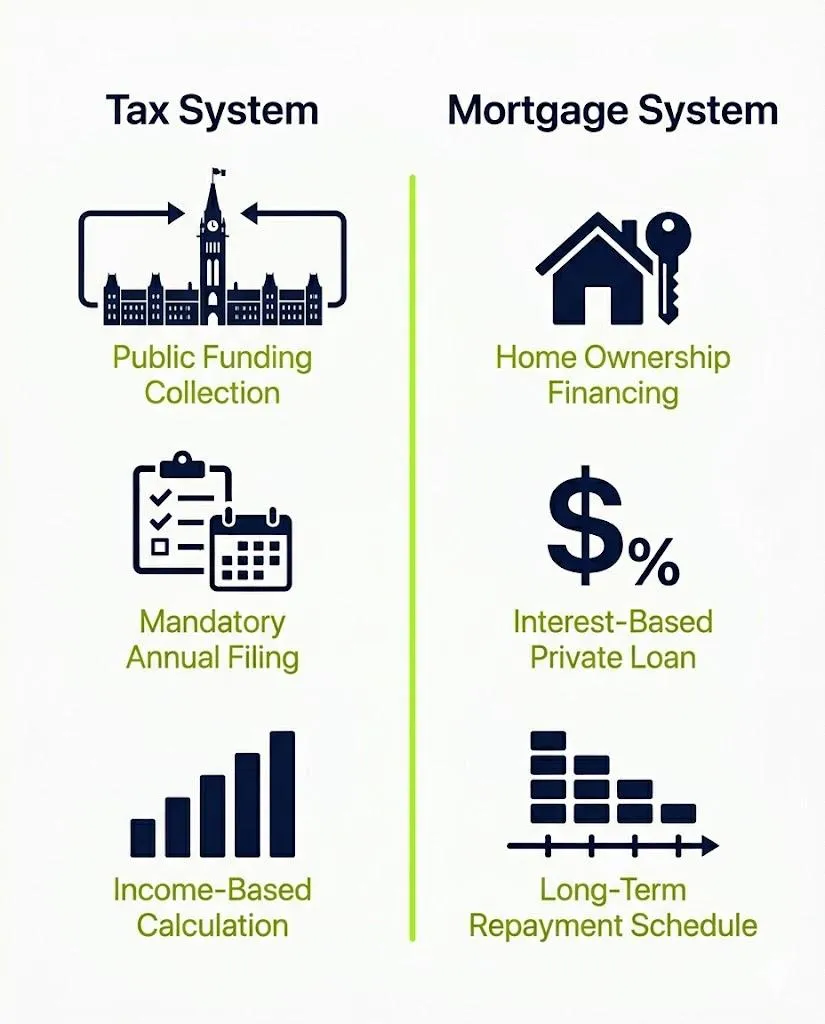
CRA and mortgage lenders are not talking to each other. Your accountant optimized for one system (lowering your taxes).
The Tax System (CRA)
Your accountant's job is to minimize your declared income and tax burden. That is exactly what they should be doing. It is not a mistake; it is the strategy working as intended.
The Mortgage System (Lenders)
Most lenders require T4 income, which means you pay higher income taxes, minimizing your income to qualify. But some lenders evaluate income differently, and those are the ones we find.
You are likely much closer to qualifying
than your bank led you to believe.
The Question Nobody Asks
Is the One That Changes Everything
Would you rather pay a higher marginal tax rate or a slightly higher mortgage rate?
That is the question we actually need to answer.
53%+
Ontario's top marginal tax rate. Paying yourself more T4 income to qualify at a bank triggers this.
As low as 0.5%
The typical rate premium on a B lender mortgage compared to an A lender.
$43,000+
The income tax cost of declaring an extra $100,000 in T4 salary to qualify at a bank.
Programs and Lenders Built for How Your Business
Actually Works
Business Statement Programs
Qualification Based on What Your Business Actually Earns
Lenders who assess deposits and revenue rather than T4 income are designed specifically for incorporated and self-employed borrowers.
Beacon Score Positioning
Your Credit Profile Matters
Before the application goes anywhere, we review your credit score and utilization to address anything that could affect your rate or approval in advance.
The Graduation Path
If Moving Back to an A Lender Is the Goal, We Build Toward It from Day 1
Income structure, mortgage terms, and timeline. All set up so the transition is as short and clean as possible when you are ready.
Already Built Equity
and Want to Access It?
If you want to consolidate high-interest debt, fund a business investment, or purchase another property, the conversation looks a little different for self-employed borrowers. The structure of your refinance matters as much as the approval itself. Getting it right from the start avoids expensive corrections later.
Explore Refinancing as a Self-Employed Borrower

Here Is What Working Together Actually Looks Like
The Conversation
Not a form. Not a credit pull. I want to understand your business structure, how you pay yourself, and what you are trying to do. You bring the context. I bring the questions.
The Full Picture
We review your tax filings, your business banking statements, and your overall financial position. Then I identify which lenders and programs fit your specific structure and compare the real cost of each path.
The Decision
You choose with confidence. Whether that is an A lender, an alt lender, or a structured path between the two, the decision makes sense for your business and your tax strategy.
I Don't Disappear When the Mortgage Closes
Self-employed income does not stay the same year over year. Your mortgage strategy should reflect where your business is going, not just where it was when you signed.
Your mortgage file does not close when you sign.
It evolves as your business does.
Monthly
You receive a monthly update on your property value and mortgage position so you always know where you stand.
Annually
We talk about what has changed in your business and whether the mortgage structure still fits.
In their words.
★★★★★
"He patiently guided us through every step of the process and took the time to answer any clarifying questions. One of Colin's strengths is problem-solving and finding creative ways to explain as well as find solutions."
RS
Business For Self/Incorporated
★★★★★
He was always accessible, responsive, and guided us through every step of the process. Our mortgage situation was not straightforward, but Colin helped us navigate all the complexities with confidence and professionalism.
ML
Self Employed Contractor
★★★★★
"He has got the mind of an investor, project manager, mortgage specialist and good human being all rolled into one. Nothing more you could hope for in a mortgage agent."
HT
Business Owner/Real Estate Investor
You Don't Have to Figure This Out on Your Own.
There is no such thing as a question that is too basic.
The only one that costs you is the one you do not ask.
No obligations. No forms before we talk.
Just a conversation.
A Few Of Our Partners






Frequently Asked Questions
These are the questions I hear most often from self-employed and incorporated borrowers.
How do lenders qualify self-employed borrowers in Canada?
Most traditional lenders use a two-year average of your declared personal income from your T1 General and Notice of Assessment. The challenge for self-employed borrowers is that a good accountant has minimized that number to reduce your tax liability. Alternative lenders have a different approach; they assess your business bank statements and actual deposits to calculate qualifying income, which more accurately reflects what your business earns.
Can I qualify for a mortgage if my T4 income is very low?
Yes, in many cases. If your business generates strong revenue that shows up in your bank statements, there are lenders who can use that activity to calculate your qualifying income. I have helped clients increase their qualifying income by several hundred thousand dollars by using business statements rather than T4 income. The file has to be structured correctly, but a low T4 is not automatically a dead end.
What is the difference between an A lender and a B lender for self-employed borrowers?
A lenders are chartered banks and credit unions with the most competitive rates and the strictest qualification requirements. B lenders are alternative lenders who take a broader view of income and credit, including business bank statement programs. Lenders like First National Excalibur, Strive, Aspire, Equitable Bank, and Home Trust offer programs specifically designed for self-employed borrowers that A lenders cannot match. B lender rates are typically 1 to 2 percent higher. For self-employed borrowers whose accountant has minimized declared income, that rate difference is often significantly cheaper than the income tax cost of qualifying at an A lender.
What is a business bank statement mortgage?
A business bank statement mortgage qualifies you based on your actual business revenue and deposits rather than your declared T1 income. Lenders review 12 to 24 months of business banking activity to establish your income. This is specifically designed for incorporated business owners and self-employed borrowers whose taxable income does not reflect their true earning capacity.
Do I need two years of self-employment history to get a mortgage in Canada?
Traditional A lenders typically want to see a two-year history of self-employment income before they will qualify you. However, alternative lenders can be more flexible depending on your business banking history, your credit profile, and the overall strength of your file. If you are newer to self-employment, the two-year window is not always a hard stop.
Should I pay myself more T4 income to qualify for a mortgage?
This is the wrong question for most incorporated business owners. Paying yourself enough T4 income to qualify at a bank triggers a significant personal income tax liability. Ontario's top marginal rate exceeds 53%. A slightly higher mortgage rate through an alternative lender typically costs far less than the income tax on the salary you would need to declare. We run that comparison specifically for your situation before making any recommendation.
Will using a B lender hurt my ability to get an A lender mortgage later?
Not if we structure it correctly from the start. Some clients use a B lender as a transitional step and move to an A lender at renewal by adjusting their income structure over time. Others determine that staying on the alt side permanently is the right financial decision given their tax strategy. We build the plan based on where you want to end up, not just where you are today.
I was declined by my bank. Does that mean I cannot get a mortgage?
No. Your bank evaluated your application against their specific qualification criteria, which typically rely heavily on T4 income. That is one system. There are other lenders using different systems. A decline from one institution is not a final answer, it is information about which door to use next.
Licensed mortgage agent and investor.
Strategy-first advice. 25+ years in Canadian real estate and mortgage strategy
The Mortgage Builder
REGULATORY TRANSPARENCY
License: Mortgage Agent, FSRA Ontario | Lic. M22000539
Brokerage: BRX Mortgage
Colin Ballantyne is a licensed mortgage agent with BRX Mortgage.
Not all applicants will qualify. This website is for informational purposes only and does not constitute financial advice.
© 2026 Colin Ballantyne — All rights reserved.